

War Is Not Just Killing Them. It Is Forming Us.

I received the news of the U.S./Israel attacks on Iran the way most of us do now: mid-sentence, mid-scroll, mid-life. When the headline surfaced, I felt that familiar tightening in my chest. It wasn’t shock. It was the recognition that this kind of news no longer arrives as rupture, but as routine.
That alone is worth lamenting…yet there is far more to grieve.
I lament that the purveyors of power continue to reach for violence as their most trusted tool. I lament that, while some celebrate the death of Iran’s Supreme Leader as their liberation, civilians and the poor will disproportionately bear the costs of this war. I lament that this decision, like similar ones before, will be paid for in human souls, in fear, in displacement, in long nights, and shortened futures. I lament that violence is still imagined as a necessary, righteous cleansing force rather than what it actually is: a distraction from other insidious realities, a multiplier of trauma, and a guarantor of future war. I lament that so many see this tired, ineffective human pattern of violence as something novel, and that too many imagine it as endorsed by Jesus.
Deepening my grief is how practiced we’ve become at absorbing it.
Prolonged violence is doing something to us. It certainly dehumanizes the victims who are bombed, surveilled, sanctioned, and erased. But it also quietly reshapes those of us who watch from a distance. It trains us to speak in euphemisms. It teaches us to accept the language of “necessity.” Prolonged violence lowers our expectations for what is possible and raises our tolerance for what should never be normal. Violence doesn’t just break bodies. It calcifies hearts.
Those of us more proximate to power, we who are distant from the physical violence, are especially vulnerable to this malformation, not because we’re cruel, but because we’re insulated. Our homes remain intact. Our children sleep through the night. Our bodies do not learn the sound of drones or feel the shockwaves of missiles.
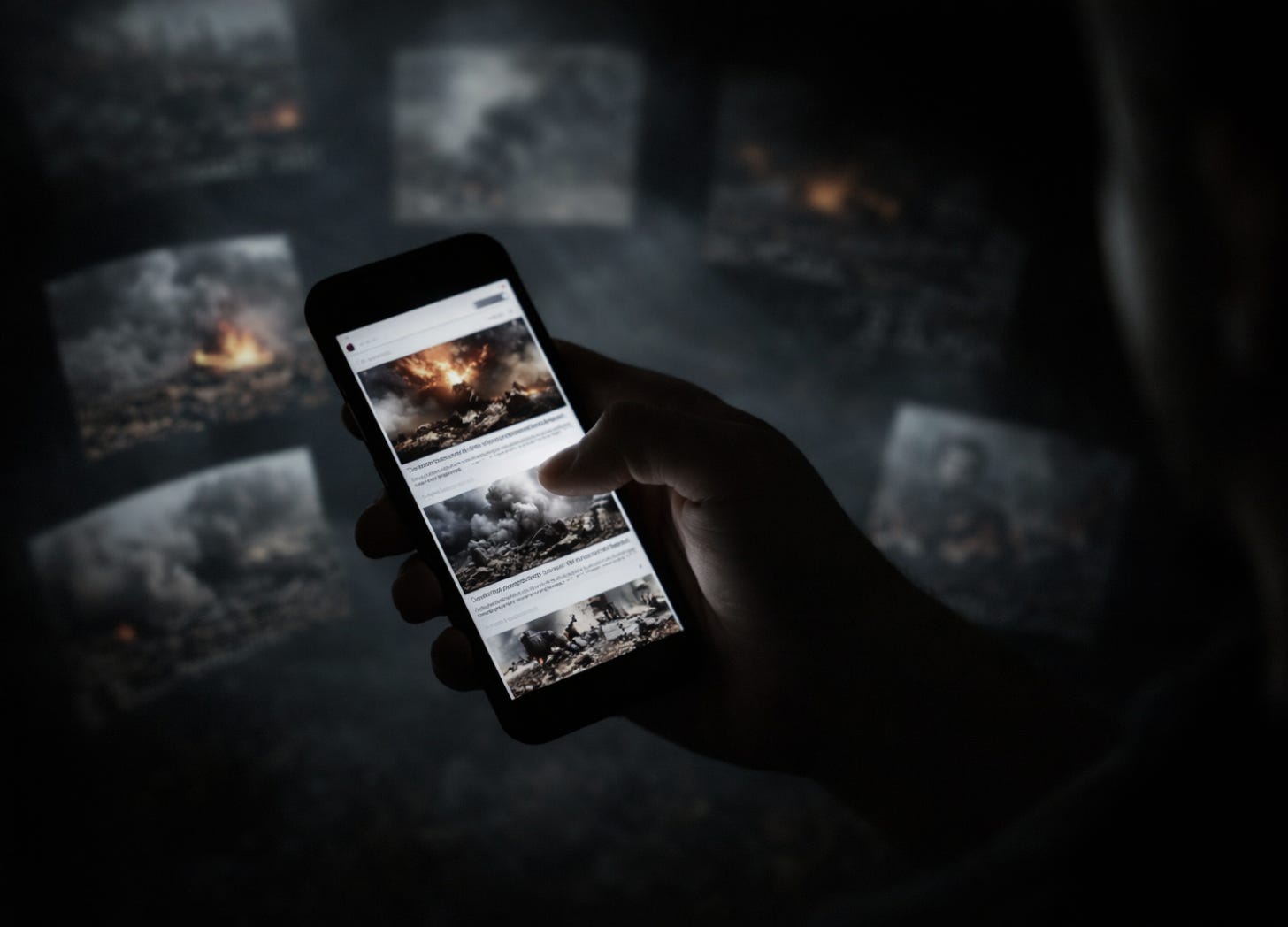
Violence arrives to us not as terror, but as information that has already been translated into press briefings, expert panels, and strategic language curated to calm rather than disturb. We’re given explanations and rationales rather than experiences and relationships. We’re offered convenient justifications for violence long before we understand who benefits from the destruction.
As we consume, we’re subtly discipled to trust that someone, somewhere behind closed doors, with better data and higher clearance, has done the math. That they’ve weighed lives and outcomes and determined that this violence is necessary. And because we’re spared the immediate cost, we’re tempted to accept their calculus as wisdom.
This is how our moral agency erodes.
Over time, we start to believe that because we’re far away, we’re powerless. Because the problem is so large, any response must be insignificant. We start to believe that awareness itself is a form of participation. So we read. We shake our heads. We say, This is heartbreaking…
…and then we move on, regretting that emotional acknowledgment isn’t the same as faithful action. We move on, knowing that awareness without action is slowly training us to live with contradictions we would otherwise resist.
This is the quiet violence done to the soul.
The balm is found in rejecting the lie that distance makes action impossible. Our healing is found when we let explanations give way to encounter. When awareness presses us toward costly love. When we choose, again and again, to stay human within an age of endless war.
So what does this mean for us who are moved by what we read and long to practice peace?
It means that we refuse the malformation by choosing slow, embodied, costly formation that runs counter to the pace of a violent age. We become the kind of people who do not outsource our moral agency to institutions, “experts,” or algorithms. We take responsibility for who we’re becoming in response to what we’re witnessing.
Very practically, this looks like retraining our proximity. We draw near to those whose lives have been upended by previous U.S. military interventions and who seek refuge here: those from Afghanistan, Iraq, Syria, Palestine, Vietnam, Cambodia, Laos, Somalia, Burma, and the Democratic Republic of Congo, to name a few. We do so understanding them as neighbors whose stories re-humanize what violence has abstracted. Proximity interrupts euphemism. Real stories undo fabricated fables.
It looks like disciplining our attention. We resist the endless consumption of violent news without embodied responses. We slow our scrolling. We grieve intentionally. We ask: What is this forming in me? And when awareness rises, we let it push us toward prayer, giving, advocacy, and presence.
It looks like practicing listening, forgiveness, and hospitality in small, stubborn ways. We refuse the lie that peace is only forged in summits and treaties. We practice it at dinner tables, in congregations, in workplaces, and in neighborhoods further fractured by disagreement about this war. We learn to stay present in tension. We listen without rushing to win. We tell the truth without surrendering our humanity or sacrificing theirs.
And finally, it looks like anchoring ourselves daily to Jesus, the one who refused domination, who absorbed violence without returning it, and who trusted that love practiced faithfully would outlast every empire built on greed and fear. We pray not to escape the world, but to stay tender within it.
This is how the hopeful alternative takes flesh. Not all at once, not from the top down, but through ordinary people who refuse to be desensitized, who choose costly love over convenient distance, and who insist, even now, that another way is possible.
Hopeful Alternative is a free subscription from Global Immersion. Your generosity keeps this work alive. If this message speaks to you, would you consider giving today.
Thanks for reading Hopeful Alternative! Subscribe for free to receive new posts and support Global Immersion’s work.